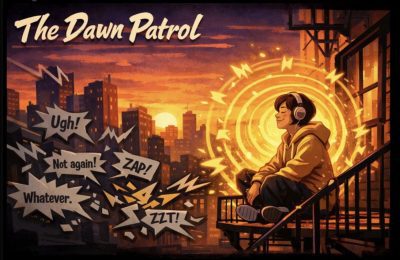
The sun doesn’t ask for permission to rise. It just does. It creeps over the concrete horizon, painting the brickwork in hues of amber and bruised purple, offering a fresh slate before the city fully wakes up to its own roar. For many of us, those first few moments of light are a sanctuary—a silent “Tabernacle of the Morning” where we sip our coffee and calibrate our internal compass. But then, the frequency shifts.
You know the sound. It’s not the birds or the distant hum of the 6:00 AM bus. It’s the sharp, discordant note of a voice that hasn’t even said “hello” yet but has already managed to launch a heat-seeking missile of negativity into your living room or your workspace. Before the “good” has even had a chance to meet the “morning,” you’re hit with a critique, a sarcastic jab about the dishes, or a guilt-laden sigh about something that happened three Tuesdays ago.
This isn’t just a bad mood; it’s a rhythmic disruption. As someone who has spent decades studying the intersection of culture, soul, and social dynamics, I see this for what it is: a power play in the key of minor. It is a social science phenomenon where the “First Contact” of the day is used not to build a bridge, but to assert a boundary of misery.
The Anatomy of the Morning Sniper
In the world of music, the first four bars of a song set the “vibe.” If those bars are out of tune, the whole track feels off-kilter. When someone chooses to lead with negativity, they are effectively “sampling” your peace and looping it into their own chaotic track.
Why does it happen? From a social science perspective, morning negativity is often a defense mechanism disguised as an offense. The “Morning Sniper” is often someone who feels a lack of control in their own life. By launching a sarcastic comment or a guilt trip before you’ve even rubbed the sleep from your eyes, they are attempting to dictate the emotional climate of the environment. They are setting the “bpm” (beats per minute) of the household or the office to their own frantic, unhappy pace.
The sarcasm is particularly telling. Sarcasm, by definition, is a “tearing of the flesh.” When delivered at 7:00 AM, it acts as a preemptive strike. It says, “I am hurting or stressed, and I need you to be on my level so I don’t have to feel this way alone.” It is a cry for help wrapped in a barbed-wire blanket.
The Cultural Cost of the “Guilt-First” Greeting
We live in a society that often rewards “the grind” and “the hustle,” frequently at the expense of our emotional intelligence. Culturally, we’ve almost been conditioned to believe that if we aren’t stressed the moment our eyes open, we aren’t doing enough. This “stress-as-status” mindset trickles down into our most intimate interactions.
When a partner, roommate, or colleague skips the “Good morning” and goes straight to “I can’t believe you didn’t do X,”they are participating in a social script of transactional worth. They are saying your value to them is tied strictly to your utility, not your humanity. In the justice systems I’ve studied, we call this a “punitive environment.” When your home or office becomes a place where you are “guilty until proven caffeinated,” the psychological toll is immense.
It creates a state of “Hyper-Vigilance.” You start waking up with your shoulders already hunched, waiting for the first blow. Your morning—your sacred space for reflection and poetic thought—is now a minefield.

The Social Science of the “Vibe Shift”
There is a concept in psychology called “Emotional Contagion.” We are wired to mimic the emotions of those around us. It’s an evolutionary survival trait. If the leader of the tribe is looking at the bushes with fear, you look at the bushes with fear.
When you are met with negativity first thing in the morning, your brain’s amygdala—the “smoke detector” for threats—flashes red. Even if the comment is “just a joke” or a small complaint about the mail, your body reacts as if it’s under attack. Your cortisol levels spike. You haven’t even finished your toast, and you’re already in “fight or flight” mode.
The tragedy here is that this negativity is a feedback loop. The more they throw, the more you retreat or snap back, which “validates” their original negative stance. It’s a broken record that skips on the same scratchy line, day after day.
The Actionable Gem: The “Beat-Drop” Pause
So, how do we break the loop? How do we handle the “Morning Sniper” without losing our own rhythm?
Here is the gem: Practice the “Beat-Drop” Pause.
In hip-hop, the “beat-drop” is that moment of silence or transition where the track resets. When someone hits you with that first-sentence negativity, do not respond to the content of their words immediately. Instead, acknowledge the frequency they are on, but stay on your own.
If they say: “Must be nice to just sit there while the kitchen is a mess,” instead of defending yourself (which feeds the static), try the “Frequency Reset.”
-
The Silent Count: Take three seconds. Don’t speak. This breaks their expected “call and response” rhythm.
-
The Human Greeting: Respond with the greeting they skipped. “Good morning. I’m still waking up. I’ll be happy to talk about the kitchen in twenty minutes once I’ve finished my coffee.”
-
The Boundary Line: You are essentially saying, “I hear your noise, but I am not letting it into my song.”
This is an empowering move. It’s not about being “preachy” or “better than”; it’s about protecting your emotional real estate. You are teaching people how to rhythmically interact with you.
Reclaiming the Morning Narrative
We have to remember that we are the authors of our own daily narrative. If someone else wants to write a tragedy starting at sunrise, that is their prerogative, but you don’t have to be a character in their play.
Dealing with chronic morning negativity requires a level of “Soul-Defense.” It’s about understanding that their sarcasm is a reflection of their internal weather, not your worth. When you see it as a “systemic” issue within them—perhaps they are overworked, perhaps they were raised in a house where silence was a threat—you can move from a place of anger to a place of “Critical Empathy.”
Critical Empathy allows you to say: “I see that you are struggling, but I will not allow your struggle to become my standard”.
The Horizon is Still Bright
It takes 21 days to build a habit, but it only takes one second to decide to change a vibe. Tomorrow morning, the sun will rise again. The “Morning Sniper” might have their finger on the trigger, ready with a sarcastic remark about the weather or the bills.
But you? You are the DJ of your own soul. You choose the track. You choose the volume.
When we stand firm in our own peace, we eventually force the world around us to adjust to our frequency. It won’t happen overnight. There will be static. There will be feedback. But stay consistent. Lead with the “Good Morning” you want to hear. Protect your Tabernacle.
The goal isn’t just to survive the morning; it’s to reclaim the beauty of the dawn. You deserve a start that feels like poetry, not a protest. Keep your head up, your heart open, and your boundaries clear.
Smile, because you’re in control of the rhythm now.





















The Dawn Patrol: Navigating the Static of Early Morning Negativity
 By R. SinclairFeb 01, 2026, 13:09 pm0
3The sun doesn’t ask for permission to rise. It just does. It creeps over the concrete horizon, painting the brickwork in hues of amber and bruised purple, offering a fresh slate before the city fully wakes up to its own roar. For many of us, those first few moments of light are a sanctuary—a silent “Tabernacle of the Morning” where we sip our coffee and calibrate our internal compass. But then, the frequency shifts.
You know the sound. It’s not the birds or the distant hum of the 6:00 AM bus. It’s the sharp, discordant note of a voice that hasn’t even said “hello” yet but has already managed to launch a heat-seeking missile of negativity into your living room or your workspace. Before the “good” has even had a chance to meet the “morning,” you’re hit with a critique, a sarcastic jab about the dishes, or a guilt-laden sigh about something that happened three Tuesdays ago.
This isn’t just a bad mood; it’s a rhythmic disruption. As someone who has spent decades studying the intersection of culture, soul, and social dynamics, I see this for what it is: a power play in the key of minor. It is a social science phenomenon where the “First Contact” of the day is used not to build a bridge, but to assert a boundary of misery.
The Anatomy of the Morning Sniper
In the world of music, the first four bars of a song set the “vibe.” If those bars are out of tune, the whole track feels off-kilter. When someone chooses to lead with negativity, they are effectively “sampling” your peace and looping it into their own chaotic track.
Why does it happen? From a social science perspective, morning negativity is often a defense mechanism disguised as an offense. The “Morning Sniper” is often someone who feels a lack of control in their own life. By launching a sarcastic comment or a guilt trip before you’ve even rubbed the sleep from your eyes, they are attempting to dictate the emotional climate of the environment. They are setting the “bpm” (beats per minute) of the household or the office to their own frantic, unhappy pace.
The sarcasm is particularly telling. Sarcasm, by definition, is a “tearing of the flesh.” When delivered at 7:00 AM, it acts as a preemptive strike. It says, “I am hurting or stressed, and I need you to be on my level so I don’t have to feel this way alone.” It is a cry for help wrapped in a barbed-wire blanket.
The Cultural Cost of the “Guilt-First” Greeting
We live in a society that often rewards “the grind” and “the hustle,” frequently at the expense of our emotional intelligence. Culturally, we’ve almost been conditioned to believe that if we aren’t stressed the moment our eyes open, we aren’t doing enough. This “stress-as-status” mindset trickles down into our most intimate interactions.
When a partner, roommate, or colleague skips the “Good morning” and goes straight to “I can’t believe you didn’t do X,”they are participating in a social script of transactional worth. They are saying your value to them is tied strictly to your utility, not your humanity. In the justice systems I’ve studied, we call this a “punitive environment.” When your home or office becomes a place where you are “guilty until proven caffeinated,” the psychological toll is immense.
It creates a state of “Hyper-Vigilance.” You start waking up with your shoulders already hunched, waiting for the first blow. Your morning—your sacred space for reflection and poetic thought—is now a minefield.
The Social Science of the “Vibe Shift”
There is a concept in psychology called “Emotional Contagion.” We are wired to mimic the emotions of those around us. It’s an evolutionary survival trait. If the leader of the tribe is looking at the bushes with fear, you look at the bushes with fear.
When you are met with negativity first thing in the morning, your brain’s amygdala—the “smoke detector” for threats—flashes red. Even if the comment is “just a joke” or a small complaint about the mail, your body reacts as if it’s under attack. Your cortisol levels spike. You haven’t even finished your toast, and you’re already in “fight or flight” mode.
The tragedy here is that this negativity is a feedback loop. The more they throw, the more you retreat or snap back, which “validates” their original negative stance. It’s a broken record that skips on the same scratchy line, day after day.
The Actionable Gem: The “Beat-Drop” Pause
So, how do we break the loop? How do we handle the “Morning Sniper” without losing our own rhythm?
Here is the gem: Practice the “Beat-Drop” Pause.
In hip-hop, the “beat-drop” is that moment of silence or transition where the track resets. When someone hits you with that first-sentence negativity, do not respond to the content of their words immediately. Instead, acknowledge the frequency they are on, but stay on your own.
If they say: “Must be nice to just sit there while the kitchen is a mess,” instead of defending yourself (which feeds the static), try the “Frequency Reset.”
The Silent Count: Take three seconds. Don’t speak. This breaks their expected “call and response” rhythm.
The Human Greeting: Respond with the greeting they skipped. “Good morning. I’m still waking up. I’ll be happy to talk about the kitchen in twenty minutes once I’ve finished my coffee.”
The Boundary Line: You are essentially saying, “I hear your noise, but I am not letting it into my song.”
This is an empowering move. It’s not about being “preachy” or “better than”; it’s about protecting your emotional real estate. You are teaching people how to rhythmically interact with you.
Reclaiming the Morning Narrative
We have to remember that we are the authors of our own daily narrative. If someone else wants to write a tragedy starting at sunrise, that is their prerogative, but you don’t have to be a character in their play.
Dealing with chronic morning negativity requires a level of “Soul-Defense.” It’s about understanding that their sarcasm is a reflection of their internal weather, not your worth. When you see it as a “systemic” issue within them—perhaps they are overworked, perhaps they were raised in a house where silence was a threat—you can move from a place of anger to a place of “Critical Empathy.”
Critical Empathy allows you to say: “I see that you are struggling, but I will not allow your struggle to become my standard”.
The Horizon is Still Bright
It takes 21 days to build a habit, but it only takes one second to decide to change a vibe. Tomorrow morning, the sun will rise again. The “Morning Sniper” might have their finger on the trigger, ready with a sarcastic remark about the weather or the bills.
But you? You are the DJ of your own soul. You choose the track. You choose the volume.
When we stand firm in our own peace, we eventually force the world around us to adjust to our frequency. It won’t happen overnight. There will be static. There will be feedback. But stay consistent. Lead with the “Good Morning” you want to hear. Protect your Tabernacle.
The goal isn’t just to survive the morning; it’s to reclaim the beauty of the dawn. You deserve a start that feels like poetry, not a protest. Keep your head up, your heart open, and your boundaries clear.
Smile, because you’re in control of the rhythm now.
Related articles
The Anatomy of the Agitator: Why We Set Fire to Our Own Shelters
The Concrete Glass: Confidence, Cracks, and the Weight of the Mic
Unmasking the Clipboard Kings