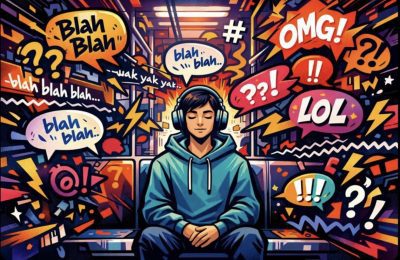
There is a specific kind of frequency that exists in the modern world—not the low-end rumble of a bassline through a brick wall, nor the rhythmic clatter of a subway train on a rusted track. It is a human frequency, a relentless, high-decibel stream of consciousness that refuses to acknowledge the existence of the pause. We have all stood in its path. It is the colleague who treats your workspace like a personal podcast studio; the neighbor who anchors you to your own front door with a chain of rhetorical questions; the friend who views a three-second lull in conversation as a vacuum that must be filled with the granular details of their morning commute.
In the industry of human connection, we often talk about the importance of being “heard.” But we rarely discuss the social tax of being “forced to listen.” When someone fills every gap, every silence, and every shared moment with random banter—expecting you to engage regardless of your interest, your workload, or your emotional capacity—they aren’t just talking. They are occupying your mental real estate without a lease. And when they take offense at your lack of enthusiasm? That’s when the social contract hasn’t just been bent; it’s been shredded.

The Anatomy of the Non-Stop Talker
To understand how to navigate this, we have to look at the mechanics of the “Gap-Filler.” In music, particularly in the genres that defined the streets—jazz, hip-hop, soul—the “rest” is as vital as the note. The silence between the beats is where the groove lives. If a drummer hit every piece of his kit every second for four minutes, it wouldn’t be a song; it would be a headache.
Yet, in social dynamics, many people are terrified of the “rest.” For some, silence feels like a failure of hospitality. For others, it’s a manifestation of a deep-seated anxiety—a fear that if the air isn’t vibrating with sound, the connection is dying. Then there is the “Rhetorical Archer,” the person who fires off questions not because they want an answer, but because they want to ensure your eyes stay locked on theirs. They ask, “Can you believe this weather?” or “Did you see that post?” while you are clearly mid-email or mid-thought, essentially demanding a “receipt” of your attention.
The cultural weight of this is significant. We live in an era of “constant connectivity,” where the expectation is that we are always “on.” But there is a massive difference between being available and being obligated. When a person expects you to engage with their every whim, they are asserting a hierarchy. They are saying, “My need to be heard is more important than your need to think, to work, or simply to be.”
The Cognitive Load and the Social Overdraft
Let’s get into the social science of it. Every interaction requires a piece of your “cognitive budget.” When you are deep in a task or even just lost in a daydream, your brain is operating at a specific frequency. When someone interrupts that with a “Wait, let me ask you this…” followed by a story that has no ending, they are forcing your brain to “task-switch.”
Research tells us that it can take several minutes to regain deep focus after a trivial interruption. Now, multiply that by fifteen interruptions in an hour. By the end of the day, you aren’t just tired; you are in a state of “social overdraft.” You have spent more energy than you’ve earned.
The most frustrating part of this dynamic is the “Offense Factor.” You know the look: the subtle pout, the “Oh, sorry for bothering you” said with enough sarcasm to fill a stadium, or the cold shoulder that follows when you provide a one-word answer to a five-minute monologue. This is a form of emotional labor. They are demanding that you not only listen but that you perform “Interest” with a capital I. They want the nod, the “Wow, really?”, the “That’s crazy.” They want you to be the hype-man for their internal monologue.
The Reclamation of the Pause
So, how do we handle the people who won’t stop talking without losing our own humanity or our reputation for being “cool”? It starts with realizing that your silence is not a weapon; it is a boundary. You do not owe anyone a performance of engagement at the expense of your peace.
The first step is de-coupling the idea of “politeness” from “compliance.” You can be the kindest person in the room and still be the most unavailable. We have been conditioned to believe that ignoring a question—even a rhetorical, pointless one—is a sin. But in the landscape of the urban hustle, survival requires a filter.
The Actionable Gem: The “Graceful Pivot”
Here is a tool for your kit—something to help you navigate the noise without burning the bridge. I call it The Graceful Pivot.
When you are trapped in a cycle of unsolicited banter, don’t wait for a natural pause, because with a non-stop talker, that pause isn’t coming. You have to create the “rest” in the music yourself. Instead of offering a “Yeah” or a “Wow,” which only fuels the fire, use the “Acknowledge and Close” method:
“I hear you, and I’d love to dive into that when I’m not in the middle of this thought/task. I’m going to go dark for a bit to focus.”
The key here is the “Going Dark” phrasing. It isn’t an insult; it’s a status update. It informs the other person that the “On” air light has been turned off. If they take offense, that is a reflection of their boundary issues, not your character. You are teaching people how to tune into your station, rather than letting them broadcast over yours.
The Cultural Shift: Why We Need the Quiet
If we look at the history of social movements and creative revolutions, they didn’t happen in a vacuum of constant chatter. They happened in the spaces where people had the room to think. When we allow our environments to be dominated by the loudest, most persistent voices—even if they are “friendly”—we lose the ability to hear the subtle, more important truths of our own lives.
We need to foster a culture where silence is respected as a form of presence. Being in the same room with someone and not speaking is a high level of intimacy. It says, “I am comfortable enough with you that I don’t need to entertain you.” The people who won’t stop talking are often the ones who are the least comfortable with themselves. By holding your boundary, you might actually be doing them a favor. You are inviting them to sit with the silence, too.
The Optimistic Horizon
Dealing with the “Banter-Bots” of the world can be draining, but there is a silver lining. Every time you successfully navigate one of these interactions with your peace intact, you are strengthening your “Social Sovereignty.” You are reclaiming your time, your energy, and your focus.
The world is loud enough. You don’t have to add to the noise, and you certainly don’t have to be its designated audience. Tomorrow, when the random questions start flying or the rhetorical traps are laid, remember that you are the conductor of your own symphony. You decide when the music plays and when the “rest” begins.
Smile, acknowledge the human in front of you, but stay fiercely protective of your inner quiet. Because in the end, the most important conversation you’ll have today is the one happening inside your own head—and it deserves to be heard without interruption.
Keep your head up, your boundaries firm, and your playlist of inner peace on repeat.






















Tyranny of the Unsolicited
 By R. SinclairFeb 01, 2026, 22:24 pm0
0There is a specific kind of frequency that exists in the modern world—not the low-end rumble of a bassline through a brick wall, nor the rhythmic clatter of a subway train on a rusted track. It is a human frequency, a relentless, high-decibel stream of consciousness that refuses to acknowledge the existence of the pause. We have all stood in its path. It is the colleague who treats your workspace like a personal podcast studio; the neighbor who anchors you to your own front door with a chain of rhetorical questions; the friend who views a three-second lull in conversation as a vacuum that must be filled with the granular details of their morning commute.
In the industry of human connection, we often talk about the importance of being “heard.” But we rarely discuss the social tax of being “forced to listen.” When someone fills every gap, every silence, and every shared moment with random banter—expecting you to engage regardless of your interest, your workload, or your emotional capacity—they aren’t just talking. They are occupying your mental real estate without a lease. And when they take offense at your lack of enthusiasm? That’s when the social contract hasn’t just been bent; it’s been shredded.
The Anatomy of the Non-Stop Talker
To understand how to navigate this, we have to look at the mechanics of the “Gap-Filler.” In music, particularly in the genres that defined the streets—jazz, hip-hop, soul—the “rest” is as vital as the note. The silence between the beats is where the groove lives. If a drummer hit every piece of his kit every second for four minutes, it wouldn’t be a song; it would be a headache.
Yet, in social dynamics, many people are terrified of the “rest.” For some, silence feels like a failure of hospitality. For others, it’s a manifestation of a deep-seated anxiety—a fear that if the air isn’t vibrating with sound, the connection is dying. Then there is the “Rhetorical Archer,” the person who fires off questions not because they want an answer, but because they want to ensure your eyes stay locked on theirs. They ask, “Can you believe this weather?” or “Did you see that post?” while you are clearly mid-email or mid-thought, essentially demanding a “receipt” of your attention.
The cultural weight of this is significant. We live in an era of “constant connectivity,” where the expectation is that we are always “on.” But there is a massive difference between being available and being obligated. When a person expects you to engage with their every whim, they are asserting a hierarchy. They are saying, “My need to be heard is more important than your need to think, to work, or simply to be.”
The Cognitive Load and the Social Overdraft
Let’s get into the social science of it. Every interaction requires a piece of your “cognitive budget.” When you are deep in a task or even just lost in a daydream, your brain is operating at a specific frequency. When someone interrupts that with a “Wait, let me ask you this…” followed by a story that has no ending, they are forcing your brain to “task-switch.”
Research tells us that it can take several minutes to regain deep focus after a trivial interruption. Now, multiply that by fifteen interruptions in an hour. By the end of the day, you aren’t just tired; you are in a state of “social overdraft.” You have spent more energy than you’ve earned.
The most frustrating part of this dynamic is the “Offense Factor.” You know the look: the subtle pout, the “Oh, sorry for bothering you” said with enough sarcasm to fill a stadium, or the cold shoulder that follows when you provide a one-word answer to a five-minute monologue. This is a form of emotional labor. They are demanding that you not only listen but that you perform “Interest” with a capital I. They want the nod, the “Wow, really?”, the “That’s crazy.” They want you to be the hype-man for their internal monologue.
The Reclamation of the Pause
So, how do we handle the people who won’t stop talking without losing our own humanity or our reputation for being “cool”? It starts with realizing that your silence is not a weapon; it is a boundary. You do not owe anyone a performance of engagement at the expense of your peace.
The first step is de-coupling the idea of “politeness” from “compliance.” You can be the kindest person in the room and still be the most unavailable. We have been conditioned to believe that ignoring a question—even a rhetorical, pointless one—is a sin. But in the landscape of the urban hustle, survival requires a filter.
The Actionable Gem: The “Graceful Pivot”
Here is a tool for your kit—something to help you navigate the noise without burning the bridge. I call it The Graceful Pivot.
When you are trapped in a cycle of unsolicited banter, don’t wait for a natural pause, because with a non-stop talker, that pause isn’t coming. You have to create the “rest” in the music yourself. Instead of offering a “Yeah” or a “Wow,” which only fuels the fire, use the “Acknowledge and Close” method:
The key here is the “Going Dark” phrasing. It isn’t an insult; it’s a status update. It informs the other person that the “On” air light has been turned off. If they take offense, that is a reflection of their boundary issues, not your character. You are teaching people how to tune into your station, rather than letting them broadcast over yours.
The Cultural Shift: Why We Need the Quiet
If we look at the history of social movements and creative revolutions, they didn’t happen in a vacuum of constant chatter. They happened in the spaces where people had the room to think. When we allow our environments to be dominated by the loudest, most persistent voices—even if they are “friendly”—we lose the ability to hear the subtle, more important truths of our own lives.
We need to foster a culture where silence is respected as a form of presence. Being in the same room with someone and not speaking is a high level of intimacy. It says, “I am comfortable enough with you that I don’t need to entertain you.” The people who won’t stop talking are often the ones who are the least comfortable with themselves. By holding your boundary, you might actually be doing them a favor. You are inviting them to sit with the silence, too.
The Optimistic Horizon
Dealing with the “Banter-Bots” of the world can be draining, but there is a silver lining. Every time you successfully navigate one of these interactions with your peace intact, you are strengthening your “Social Sovereignty.” You are reclaiming your time, your energy, and your focus.
The world is loud enough. You don’t have to add to the noise, and you certainly don’t have to be its designated audience. Tomorrow, when the random questions start flying or the rhetorical traps are laid, remember that you are the conductor of your own symphony. You decide when the music plays and when the “rest” begins.
Smile, acknowledge the human in front of you, but stay fiercely protective of your inner quiet. Because in the end, the most important conversation you’ll have today is the one happening inside your own head—and it deserves to be heard without interruption.
Related articles
The Dawn Patrol: Navigating the Static of Early Morning Negativity
The Anatomy of the Agitator: Why We Set Fire to Our Own Shelters
The Concrete Glass: Confidence, Cracks, and the Weight of the Mic