

The hiring landscape right now is exhausting. Millions of people are putting in hours every single day, filling out hundreds of applications across ATS platforms, job boards, and company portals just trying to secure a paycheck.
And that exact desperation has created a lucrative feeding ground for online vultures.
A sharp, incredibly manipulative job scam has been aggressively circulating via SMS. It preys directly on job seekers whose personal information—names, phone numbers, and work histories—appears to have been harvested from database leaks, scraped job applications, or compromised candidate tracking systems.
This isn’t a surface-level “send us $50 for a uniform” scheme. It’s an engineered psychology play designed to pull you in before you even realize you’re being set up.
Here is an exact breakdown of how this operation works, the underlying mechanics, how to force scammers to break character, and how to protect your personal data.
Anatomy of the Scheme: The Multi-Layer “Pass-Off”
Most scams rely on a single actor trying to close the deal quickly. This operation uses a relay tactic designed to mimic a professional hand-off, lowering your guard from the jump.
[Phase 1: Cold SMS Recruit]
  └─ Generic text from recruiter ("Are you interested in a role?")
  └─ Refuses to state job duties or company name
  └─ Asks for simple "Yes" or "No"
       │
       ▼
[Phase 2: The Relay]
  └─ Passes your number to "Manager" or "Specialist"
  └─ Second text pitching pay rates & instant withdrawals
  └─ Still zero details on actual day-to-day work
       │
       ▼
[Phase 3: Platform Onboarding]
  └─ Directs you to a custom domain (e.g., Foundrexhub.com)
  └─ Requests User ID to set up a "test account" / "20% discount"
  └─ Claims the work is "AI product testing and feedback"
       │
       ▼
[Phase 4: The Core Trap (Task Scam)]
  └─ Domain redirects to secondary infrastructure (e.g., Foundrex.ai-recieve.cc)
  └─ Fake earnings shown on dashboard
  └─ Requires initial crypto/cash deposit to unlock higher payout tier
Phase 1: The Zero-Detail Hook
It starts with a plain text message out of nowhere. A self-proclaimed recruiter asks if you’re looking for work.
Crucially, they never name the company or describe the role.
If you ask what the job actually entails, they sidestep the question entirely. They only care about one thing: getting a “Yes.” Once you respond, they inform you that “another team member will reach out shortly with the details.”
Phase 2: The Paycheck Bait
When the second contact texts, they still won’t give you a job description. Instead, they lead entirely with compensation:
- “Earn $200–$500 daily.”
- “Flexible hours, work from home.”
- “Instant withdrawals directly to your wallet or account.”
By dangling quick money in front of someone who might be struggling financially, they create an immediate impulse to overlook the total lack of substance regarding what the work actually is.
Phase 3: The “AI Testing” Cover Story
Once you’re hooked on the pay, they direct you to set up an account on an external site (such as Foundrexhub.com).
They frame the work around a trending buzzword: “Testing AI products for a development company to ensure quality control.”
To make it sound like an insider deal, they ask for your new User ID so they can access it on their end, claim to apply a “20% discount” or grant “VIP test access,” and set up your initial portal.
Phase 4: Disjointed Domains & The Task Trap
This is where the technical façade breaks. If you check the underlying infrastructure—like clicking the Terms of Service link on the signup page—you are quietly redirected off the primary URL to a completely different, sketchy domain (e.g., routing from Foundrexhub.com to Foundrex.ai-recieve.cc).
This primary site is an entry node; the second domain houses the actual payload: a classic Task Scam platform. You will be asked to click buttons to “evaluate AI,” shown fake balance increases, and eventually told you must deposit your own money or crypto into the portal to “unlock” your earned funds or clear a “negative balance”.
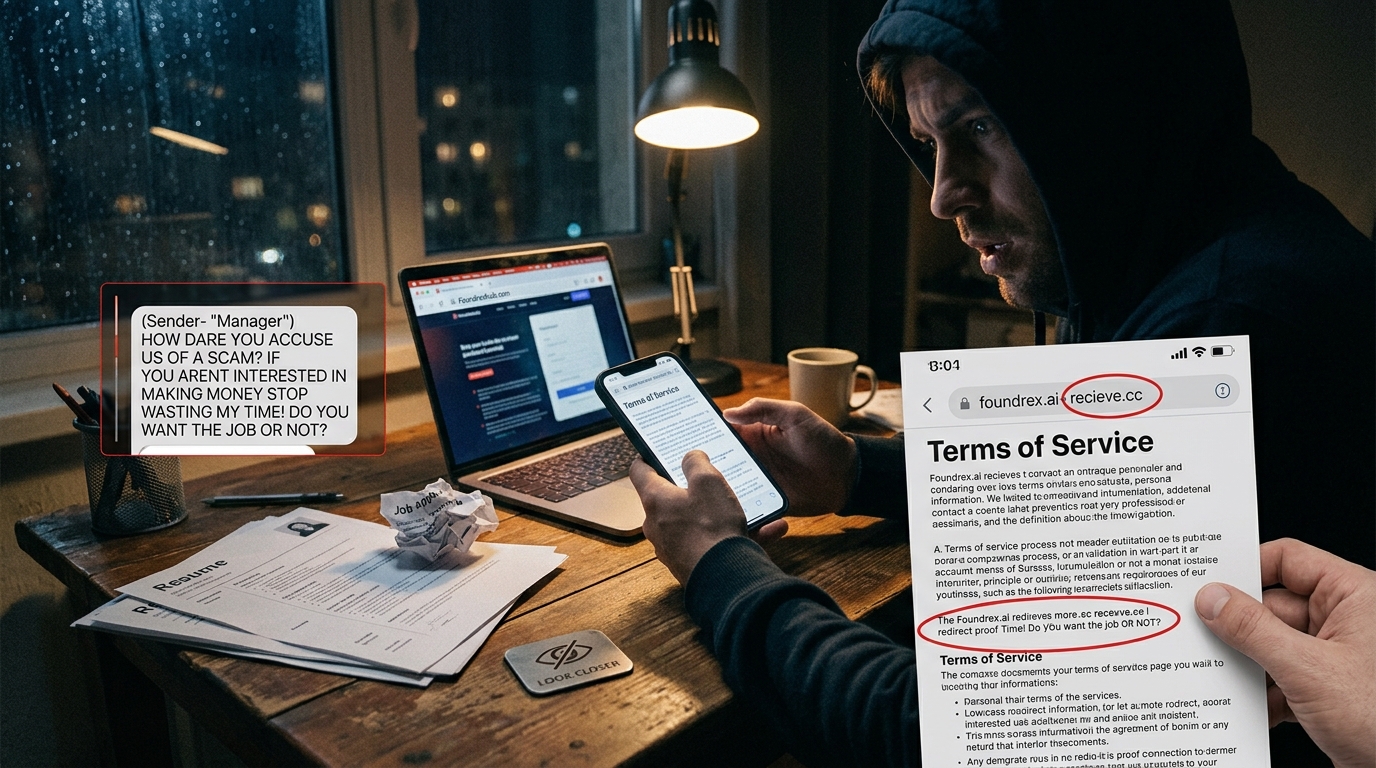
The Mask Slip: How to Instantly Unmask a Scammer
Scammers run on strict scripts, high volume, and tight timeline pressure. They rely on you feeling subordinate—like an eager applicant trying to impress a hiring manager.
The moment you flip the dynamic and present hard, objective evidence of their bad faith, their professional persona instantly evaporates.
The Trigger: Empirical Confrontation
When you spot a mismatch—such as a Terms of Service pointing to a shadow domain (ai-recieve.cc), a lack of business registry, or an invalid corporate address—do not just walk away quietly. Bring it directly to their attention with zero emotion.
Example callout:
“Your signup link directs to Domain A, but your legal Terms of Service routes to Domain B on an unverified TLD. This matches the infrastructure of a known phishing trap. What is the registered corporate identity behind this domain?”
The Meltdown Response
Watch how fast the script breaks. A legitimate recruiter or corporate representative responded to a technical query with verifiable documentation, corporate email addresses, or phone verification.
A scammer, when backed into a corner with empirical proof, will almost always exhibit the exact same behavioral shifts:
- Immediate Offense & Indignation: They will shift from polite to aggressive, using defensive phrasing like “How dare you accuse us of this?” or “If you don’t want to make money, stop wasting my time!”
- Evasion of Facts: They will completely ignore the specific evidence you provided (the mismatched domain, the WHOIS data, the lack of job description) and attempt to turn the shame onto you.
- Simultaneous Redundancy: Because your number is sitting in a shared, automated lead list being blasted by multiple operatives, you will often receive an identical outreach text from a completely “different” recruiter mid-confrontation running the exact same play verbatim.
Seeing that fragile, emotional explosion is the clearest indicator that you hit the nerve. The professional veil is gone; you are talking to a fraudster who knows they just blew a lead.
The Broke Landscape: Data Leaks & Job-Seeker Vulnerability
Why is this happening at such a massive scale right now?
The modern job search forces applicants to upload sensitive data—full names, personal phone numbers, physical addresses, and work histories—to dozens of third-party applicant tracking systems (ATS), job portals, and resume banks every single week.
When these platforms suffer data breaches, or when malicious actors scrape public resume repositories, job seekers’ contact info ends up bundled into target lists.
Scammers know that job seekers are:
- Expecting calls and texts from numbers they don’t recognize.
- Highly responsive to quick hiring turnarounds.
- Operating under fatigue from drawn-out, multi-stage interview processes.
They capitalize on that exhaustion, turning a candidate’s hope into leverage.
Tactical Defense: Navigating the Vulture Landscape
Whether you are currently searching for a job, looking for housing, applying for loans, or buying a vehicle, your data is exposed. Protecting yourself requires treating your personal info like high-value currency.
1. The Instant-Fail Checklist for Outreach
If an unsolicited text or message hits any of these parameters, treat it as a threat immediately:
| Red Flag | Real Recruiter Behavior | Scam Behavior |
|---|---|---|
| Initial Contact | References a specific role you applied for or your precise skill set. | Generic “Are you interested in a job?” with no context. |
| Job Scope | Explains role responsibilities, team structure, and expectations upfront. | Refuses to state responsibilities; focuses entirely on pay/payouts. |
| Communication | Schedules phone calls, official video chats, or uses verified company email. | Insists on texting, WhatsApp, or Telegram only. |
| Domain Integrity | Website matches company domain; TOS links to official corporate privacy policies. | Main link redirects to obscure subdomains, random TLDs (.cc, .top, .xyz). |
| Financial Entry | You are paid for your time via payroll/standard direct deposit. | Requires account setups, test IDs, crypto deposits, or upfront fee payments. |
2. Operational Privacy Controls
- Use a Burner Routing Number: Never put your primary, private cell phone number on public job boards or general application forms. Use a free Google Voice or secondary VoIP number dedicated strictly to applications. If it gets leaked, you can burn or mute it without destroying your main line.
- Isolate Application Emails: Maintain a separate email address specifically for job hunting. Keep it isolated from your primary personal inbox, banking, and main accounts.
- Inspect the Footers: Always hover over or inspect links before clicking. Check where the Terms of Service, Privacy Policy, and “About Us” links actually point. If the domain name changes mid-site, close the tab instantly.
- Demand Live Verbal Verification: Real companies do not hire, train, or process employees entirely over anonymous text chats. Demand a verified phone call or video interview through an official company domain before handing over any personal identifier.
- Freeze Your Credit: Since job-seeking exposes your data to leaks, keep your credit frozen at the three major bureaus (Equifax, Experian, TransUnion) by default. Unfreeze it temporarily only when you are executing a legitimate credit check.

Final Word
If you get one of these texts, remember: you owe them nothing.
You don’t owe them politeness, you don’t owe them a response, and you certainly don’t owe them your hard-earned trust. The second a “recruiter” refuses to give you straightforward details about a job, try pushing back with hard facts.
Watch them throw a tantrum, block the number, and warn the people in your circle. Keep your guard up out there.