

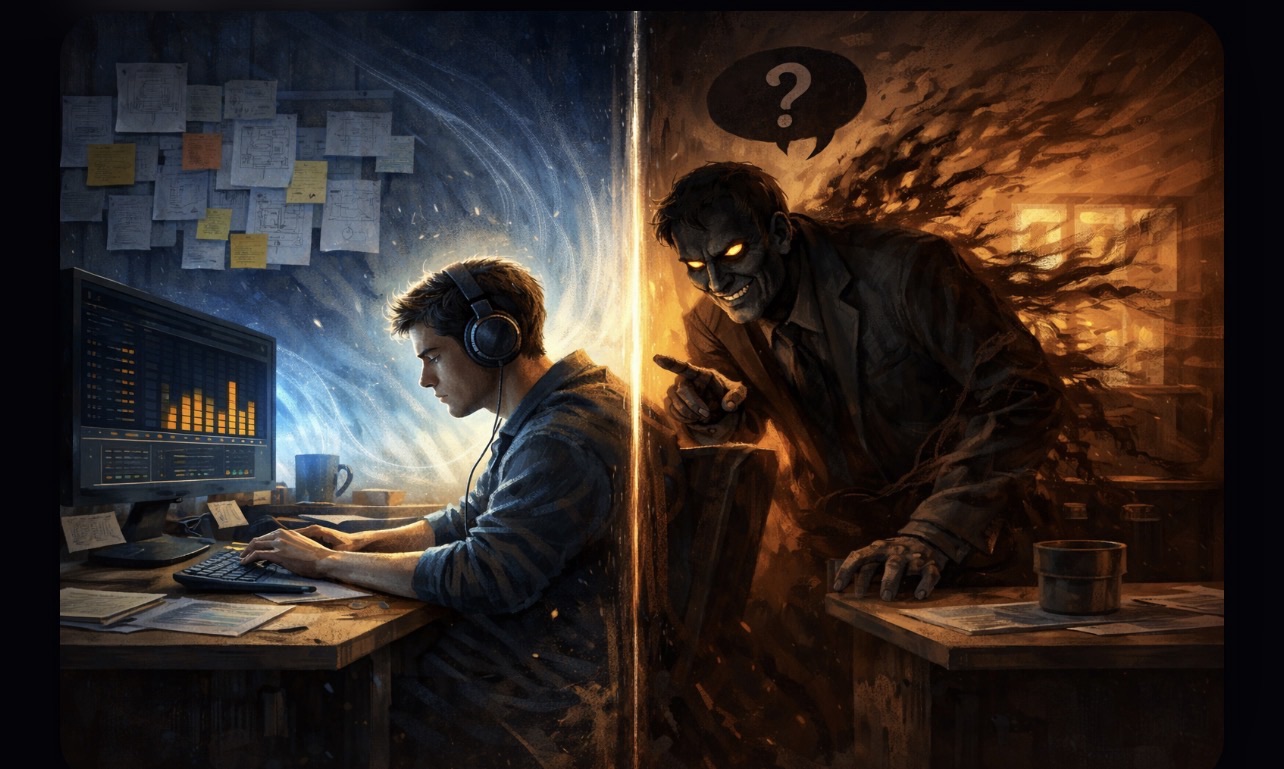
There is a specific kind of silence that exists when you are deep in the “zone.” It’s not the absence of noise, but rather the presence of a singular, vibrating focus. Whether you’re drafting a legal brief, mixing a baseline that feels like a heartbeat, or simply organizing the chaotic geometry of a community project, that focus is your most sacred currency. But there is a particular social predator that feeds on this currency: the intentional interrupter. We’ve all felt that shadow fall across our desk or heard that “quick question” that sounds more like a demand for your soul.
This isn’t about the accidental intrusion or the genuine emergency. This is about the power play—the subtle, often unconscious performance of ego where someone sees you building something and decides that their presence is more vital than your progress. In the world of social dynamics, the interruption is rarely about the information being sought; it is about the hierarchy being asserted.
The Rhythmic Theft of the “Quick Sec”
To understand the weight of an interruption, we have to look at it through the lens of rhythm. Life has a tempo. When we are working, we are composing a narrative. In hip-hop, we talk about the “pocket”—that sweet spot where the lyricist and the beat become a single entity. When you are in the pocket, the world makes sense. Everything flows.
Then comes the “Hey, you got a second?”
That phrase is a rhythmic skip. It’s a scratched record. Social science tells us that it takes an average of twenty-three minutes to get back to deep focus after a single distraction. But the interrupter doesn’t see the twenty-three minutes; they only see their “second.” By forcing you to break your flow, they are effectively claiming ownership of your time. In a society where power is often measured by who can command the attention of others, the act of interrupting is a small-scale colonization of your mental space.
It’s a performance of importance. By choosing to interrupt you specifically when you look the busiest, the interrupter is sending a coded message: My triviality is more significant than your depth. It is a refusal to acknowledge the labor being performed, especially if that labor is intellectual, creative, or spiritual.
The Social Science of the Power Play
If we peel back the layers of this behavior, we find a fascinating and often frustrating intersection of psychology and social hierarchy. In many professional and social environments, there is an unwritten rule that the “more important” person is the one who is allowed to be unavailable, while the “less important” person must always be accessible.
When someone purposely interrupts you to assert their own importance, they are engaging in a form of status-leveling. They see you achieving a state of autonomy—the “zone” is, after all, a place where you are beholden only to your task—and they feel a subconscious need to tether you back to the social grid. They need to remind you, and perhaps themselves, that you are part of a system in which they hold a certain rank.
This is particularly prevalent in spaces where power dynamics are already skewed. For those of us navigating the intersections of culture and resistance, we know that our focus is often seen as a threat. A person of color, a woman, or anyone from a marginalized background who is deeply focused on their own mastery is performing an act of rebellion. To interrupt that mastery is an attempt to re-establish control. It’s a way of saying, “I see you building your own world, but I can still knock on the door and demand you let me in.”
The Spoken Word of Resistance: Setting the Boundary
So, how do we protect the temple of our focus without becoming the very thing we despise? We have to learn the art of the “Polite Pivot.” In spoken word poetry, the silence between the lines is just as important as the words themselves. It gives the audience room to breathe and process. Your boundaries are the silences of your life.
Resistance in this context isn’t about being rude; it’s about being radiant in your resolve. When someone attempts to derail your train of thought to fuel their own ego, your response must be a reflection of your own value. You aren’t just defending a task; you are defending your right to be a creator rather than just a consumer of someone else’s needs.
We have to move away from the “culture of constant accessibility.” The digital age has lied to us, suggesting that because we can be reached at any moment via a dozen different platforms, we should be. We have become conditioned to feel guilty for being unavailable. But true productivity—the kind that changes communities and shifts paradigms—requires long stretches of unavailability.
The Actionable Gem: The “Graceful Gatekeeper” Protocol
Here is the truth: People will treat your time with exactly as much respect as you treat it yourself. If you want to stop being the victim of the “importance check,” you have to become a graceful gatekeeper of your own energy.
The Gem: Implement the “Three-Beat Delay.” When someone interrupts your flow with a non-emergency, do not look up immediately. Maintain your focus for three breaths (beats). Finish the sentence, the line of code, or the thought. This internal beat signals to your own brain that you are still in control of the transition. Then, when you do look up, lead with a “focus-frame” instead of an apology. Instead of saying, “Sorry, I’m busy,” say, “I’m currently in the middle of a deep-focus block. If this isn’t a fire, let’s sync up at 4:00 PM so I can give you my full attention.”
This approach does three things:
- It validates your work: You are explicitly stating that what you are doing has value.
- It rejects the “interruption hierarchy”: You are setting the terms of the engagement.
- It offers a solution: You aren’t being a “no” person; you are being a “not right now” person.
The Cultural Resonance of Mastery
In the history of soul and hip-hop, the “studio lock-in” is legendary. It’s a period where the outside world ceases to exist so that the art can be born. We need to bring that “lock-in” energy to our daily lives. Whether you are working in a cubicle, a kitchen, or a community center, your work deserves the dignity of uninterrupted space.
When we allow people to distract us just to satisfy their ego, we are slowly chipping away at our own potential. We are teaching our brains that our goals are secondary to the social whims of others. Over time, this erodes our confidence and our ability to produce work that has weight and meaning.
Think of the greats—the writers, the activists, the musicians. None of them achieved greatness by being “accessible” to everyone at all times. They achieved it by carving out a space where their thoughts could grow without being trampled by the boots of someone else’s “quick question.”
A Vision of Mutual Respect
Imagine a culture where we respected each other’s focus as much as we respected their physical property. Imagine walking into a room and seeing someone deep in thought and feeling a sense of awe rather than an urge to intrude. That is the world we are trying to build—a world where we understand that everyone’s “zone” is a contribution to the collective brilliance of our community.
When you protect your time, you aren’t just doing it for yourself. You are setting a standard for everyone around you. You are showing the younger generation that their thoughts have value. You are showing your peers that mastery requires discipline. And you are showing the “intentional interrupters” that their importance isn’t measured by how much of your time they can steal, but by how much they can contribute when the time is actually right.
The Optimistic Horizon
As you move through your week, remember that your focus is a flame. There will always be people who try to blow it out, not because they hate the light, but because they want to be the one holding the match. Don’t let them. Keep your head down when the work calls, keep your rhythm steady, and keep your boundaries firm.
The world needs what you are building when you are “busy.” It needs the deep thoughts, the complex solutions, and the rhythmic beauty that only comes from sustained effort. Smile at the interrupters, offer them your 4:00 PM, and then get back to the masterpiece you were creating. Your time is yours. Your focus is your power. And the job isn’t finished until you’ve turned that focus into something the rest of us can learn from, feel, and act upon.
Stay focused. Stay rhythmic. Stay you.